












Photographed on the Adventures in Oz workshop, 2012. 'The' gum at Ormiston Gorge.
Ormiston Gorge, not far from Glen Helen Gorge in the Western MacDonnells, is one of the highlights of a trip to the Red Centre. Two or three hours west of Alice Springs, it's relatively easy to visit, there's a car park, a path and once at the top, you're in the heart of it!
I first photographed this tree (I am assuming it is the same tree) some twenty years ago. Mind you, now that I think about it, perhaps it was another tree on the same spot because this tree isn't that big. Then again, maybe the trees don't grow very tall in this area. Hmmm. Last time I was there it was early morning and I have always remembered the way the white bark glowed in the pre-dawn light - and how disappointed I was because the tree was moving in the pre-dawn light and the resulting image was blurred.
The same happened on this trip, that annoying zephyr that seems to accompany dawn as it races around our globe. So while I photographed the tree in the pre-dawn light, I also remained for the sunrise so I could use a faster shutter speed and stop the movement. So, given I was using a different light source, when would the tree look its best?
Our group was up early so we had plenty of time to work out the best angles. There's a sign right next to the tree and a railing behind. In fact, the location is now a very well appointed look-out with all the trimmings required, so I had to position the camera down low so these manmade intrusions were not overly obvious. In the photo above I have removed the sign and some of the railing in Photoshop, but not in the other images which have been only quickly edited. Even so, you'll have to look hard to see them - they are pretty well hidden in the bottom right corner...
In this shot, the sunlight hasn't touched the tree as all and, to my mind, it looks less interesting than the image above.
We also had some other bushes near the camera that were intruding into the scene, so I had to gently hold them back out of the picture while each exposure was made. Please be assured that no flora was damaged in the making of this photograph.
I also took a series of images. The first had sun on the rock face, but not on the tree (shown above). The second had a splash of sun on the tops of the tree. The third had the sun extending down most of the trunk, but not lighting up the foreground. And the final one is the image at the top, where the foreground is just being kissed by the sun.
The question of when do you take the photograph was easy to answer: having travelled several days to reach my destination, I took as many frames as necessary so I could decide later on which was the 'best'.
Which would you chose? Although I have only worked the top file (the others are just out of the raw processor), you can get a feeling for how the light works on the tree. My initial thought was that the sun should only appear on the top half, not the bottom, but looking at it later, I think the sun all the way down the trunk produces great separation between the tree and the background.
If you'd like to read a blog about our Adventures in Oz workshop last year, you'll find it under the Blog menu above, or you can click here.
Black Church - Gold Award Afterall - 2013 NSW AIPP Epson Professional Photography Awards
It can be difficult working out what photos to enter in a competition. We all have a lot of emotional baggage attached to our best photos and that can cloud our vision. Mind you, to win awards, sometimes you simply have to go with your gut instinct and hope that the judges like what you do.
With my winning landscape portfolio from the 2013 NSW AIPP Epson Professional Photography Awards, I mentioned last week that one of the prints bombed. A friend thought he saw the print score 79 and, although I earned two Golds and a Silver for the other prints, I really felt a bit bummed with such a low score.
I mean, let's face it, when you enter your prints to a competition, you're pretty proud of them. You don't normally put in a photo expecting to get a bad score. However, I have been doing this for a few years and, in my arrogance, thought I knew what would score a Silver at least. So, the 79 was a problem - one point off Silver. But I couldn't complain about the judges because they had been so fair with the other scores! A bit hard to call the judges names when they obviously have such good taste with other images!
My four prints came back in their case late last week. Normally the print case gets put in the corner of the studio until it is needed, sometimes 12 months later, but I just wanted to have a look at my black church again, to try and resolve in my own mind what was wrong with it.
When I opened the case, my certificates were on top and included three golds. Oh, that's great, rub salt into the wound, I thought! Then I looked on the back of the print: the score was 90, a Gold Award!
Isn't it funny how good things like this can make you feel. I felt the whole system of judging was vindicated, even though I have written a book on photography competitions where I suggest to readers not to get too caught up in it all because, after all, it is just a matter of opinion.
So, three Golds in the State awards - what will they score at Nationals? Unfortunately, there is no guarantee they will do as well, if that's what I enter. Even so, I need to find at least another print to replace my silver!
Photography Competition Now Open - 31 July Closing Date
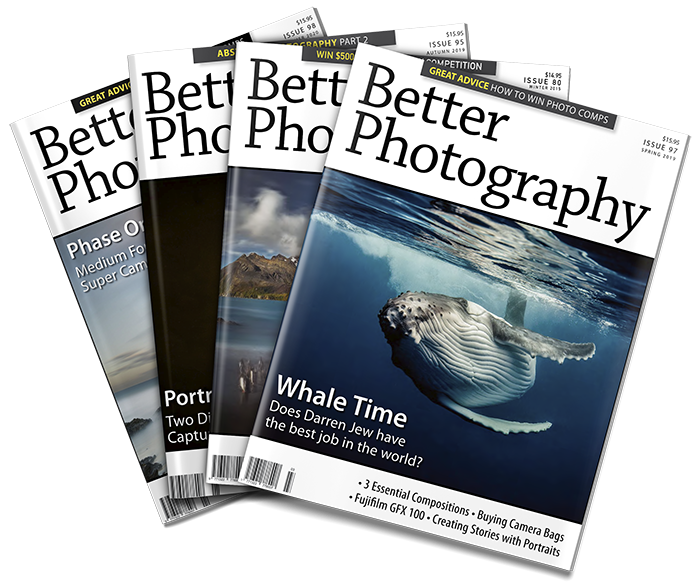
This year's annual Better Photography Magazine photo competition is open with an extended pool of category prizes, a great $5000 cash first prize, plus the promise of a short critique for every photograph entered.
Now, being mindful that entry is $20 a print or five entries for $80, the critiques are not exhaustive or in depth. However, as judges we often wish we could make a small suggestion to help the entrant improve. For instance, just to mention 'more contrast' to an entrant might indicate that their photo is a little flat, or 'Crop Image' may suggest that there is too much going on in the frame and a little judicious trimming could strengthen the composition.
So, with this in mind, each entry will get a score and a comment or suggestion. Of course, if the image has earned a high score, then the comment might simply be, "I wish I had taken this photo" - and that, I daresay, would be well-received too!
To visit the competition website, go to the Better Photography website and follow the Other Links menu, or you can go there directly by clicking here.
Salt Mine, Useless Loop, Shark Bay, Western Australia
Last week was spent in Shark Bay, the most westerly point in Australia and where Dirk Hartog landed nearly 400 years ago. I travelled with the Ninety Degrees Five (ND5) boys: Christian and Michael Fletcher, Tony Hewitt and Les Walkling. Michael was already up in Shark Bay working on another project, so the remaining four met in Perth and drove the ten hours north.
Tucked away in Shark Bay - which is absolutely huge and covers several hundred square kilometres - is a salt mine. Not quite sure if I should call it a salt mine - salt field is probably a better description. The giant pools simply sit under the sun and gradually the waters evaporate, leaving salt which is collected and shipped to Japan. As the pools change in salinity, their colour also changes and from the air you can see a great mosaic of colourful shapes. The straight edges of the mine contrast with all the other shapes and patterns in an otherwise wild and natural environment.
The image was intentionally kept flat during raw processing, so the different salt fields could be individually adjusted.
The salt fields inside their earthern walls can look relatively flat and uninteresting when captured, but if you add in some contrast, you'll find lots of interesting textures. This is what I have done to the image above. However, I have only applied the contrast to the salt fields, not the embankments between. I have also applied different amounts of contrast to different fields, creating a brushed metal look - except for the small blue field in the middle.
It was interesting to shoot these fields with the other photographers. We flew two at a time in a light plane, covering similar areas but at slightly different times of day, heights and angles. I've seen Tony and Christian's images from this area and they are amazing - and highly colourful. This may suggest why I have gone for an uncharacteristically soft colour palette!
Seljalandsfoss - Gold Award - 2013 NSW AIPP Epson Professional Photography Awards
While I was shooting from Eagle Bluff at Shark Bay, Tony's telephone rang and I saw Ryan Schembri's name. It wasn't surprising, Ryan is a good friend to both of us. However, the next thing I know the phone is being thrust into my ear and Nuran Zorlu is talking to me.
Apparently, the presentation of the NSW AIPP Epson Professional Photographer of the Year Awards is happening live back in Sydney and the finalists in the Landscape category are standing up on stage. Except me, of course. I am 5000 km away, so Nuran is standing there for me because, I am told, I am a finalist. "What do you think", asks Nuran. "Great", I say. "Hold on", says Nuran, and then eventually he comes back and says, congratulations, you're the landscape winner!
I'm asked to say a few words, I make a fool of myself in reply, but that's not unusual, and then the phone goes dead. I assume they are onto the next category award! The marvels of modern communication.
Tony says congratulations and smiles - he had just won the 2013 AIPP WA Landscape Photographer of the Year. Christian said congratulations too - he didn't win the 2013 AIPP WA Landscape Photographer of the Year, but he did win an art prize from a local school worth $10,000. He enjoyed reminded us about this for the next few days because Tony and I only received fame and trophies. However, we reckon we have the higher honours!
Congratulations to Linda Beks who won the overall AIPP NSW EPSON Professional Photographer of the Year as well as the portrait category, and I should also mention Ryan Schembri who won the travel category! One of the photos in Ryan's portfolio featured Tony and his wife Lynette, very small, in front of the Eiffel Tower - Ryan and Tony were on a Canson junket in France last year. Ahh, it's a hard life for these top photographers....
My portfolio is shown here, a series from Iceland. I must process a few more - hard to believe it is now a year ago that I was there!
Black Church - Bombed at 79 - 2013 NSW AIPP Epson Professional Photography Awards
Gullfoss - Silver Award - 2013 NSW AIPP Epson Professional Photography Awards.
Jokulsargon Berglets - Gold Award - 2013 NSW AIPP Epson Professional Photography Awards.
We went to Hamersley Gorge in Karijini for the first time this year - well, as a group that is. And we will definitely have to go there again next year, assuming our cars get there of course!
We drive to places around Karijini in convoy, leaving a kilometre or so between cars to let the dust settle. The dust isn't a problem if it is windy, but when it's still, the red mantle can hang in the air over the road for ages!
On the way out to Hamersley, Tina, Cath and I think it was Graeme had a flat tyre - in Tina's new Jeep no less! When the other students caught up to us, they reported all was okay and that Tina should be with us soon. We waited at the turnoff for 15 minutes or so, watching the light get better and better, so we decided to send the other students into the gorge with Christian, while Bruce, Tony and I drove back.
Tina's Jeep was heavenly when it had air in its tyres - there was a small fridge full of beer in the back. Well, I think it was beer...
Christian climbed out of the drivers seat and Tony took the wheel. It was only 15 kilometres or so until we found the luckless Jeep and Tony pulled over. Tony left the car running because it was hot and he didn't want the air conditioned comfort to disappear, but this was just dumb luck because if he had turned off the engine, we had no way of starting it.
The key was in Christian's pocket! It's one of these new fangled 4WD cars with an electronic key and a button ignition - as long as the electronic key is in the car, the button will work. But not if the electronic key is 15 kilometres away in someone else's pocket!
I can just imagine it. "Hi Tina, we're here to help. Oh, dear, Tina, can you give us a lift please?"
Fortunately we were in no danger. As you can see in the photo, Tina's Jeep was equipped with a small refrigerator and I'm sure there were enough beers to last until Christian returned with the key!
Overview of part of Hamersley Gorge. It was a great location to photograph.
Stuart has a think about his composition, while Tony pretends to know what he's doing with his Phase One.
The location photos were taken with the new Fujifilm X20.
Last weekend in the Hunter Valley was picture perfect for photographing landscapes - assuming you wanted to capture postcards! While many people love blue skies, David Oliver and I prefer almost any weather condition but perfect blue skies, and perhaps that's why Ken Duncan and Christian Fletcher sell more landscapes than we do because they are meeting market demand!
However, David and I had another role and that was to instruct our first Away in the Hunter Landscape Photography course. The small number of students meant plenty of individual attention and we made a mental note not to expect a large contingent on an Anzac Day public holiday weekend!
We had some great light as you can see above. The two day seminar included two shoots, one in the evening and the second the following morning. This photo was from the morning shoot around 10 kilometres away from David's farm. We arrived just as it was getting light, around 20 minutes before sunrise. I have a few frames of a similar scene in the gloaming, but it was a little later when the sunlight kissed the tops of these hills that the landscape really came to life. Timing for landscape photography is everything.
The main tweaks to the file are matters of contrast and exposure using adjustment layers in Photoshop, although much of this work could also be done in Lightroom, Aperture or Capture One. The image has been cropped a little and a telephoto lens also helped simplify the composition.
Down below to the left, out of view in this photo, is Circular Pool. Now I'm not sure who named it circular because I reckon it is more of a square, although the end of the gorge in which it is located is certainly circular. Perhaps geometry wasn't my strongest point at school, or perhaps the gorge has changed shape!
Not in a few million years, I dare say! As delightful as Circular Pool was, I remembered the way the gorge walls seemed to light up after the sun has gone down. It was a perfect evening (hard to believe it is only a week or so ago), so I headed back up the track and wandered along the escarpment. The climb out of Dales for some reason doesn't seem to take as long as the descent, but my heart and lungs no doubt thought differently.
There's so much to shoot on this walk that it's hard to know what to point your camera at. I was sidetracked a couple of times, photographing the trees that somehow managed to cling to the sides of the gorge, but as the light dropped, I made a beeline back to the lookout and set up my camera.
To the eye, it was pretty dark all around, the exception being the sky and the rich, red glow of the rock reflecting the setting sun. It is a magical sight and the only danger are the huge mosquitoes that also enjoy this time of day - I was worried they might pick me and drop me off the edge.
Okay, so I'm exaggerating about how big the mossies are, but the red in that wall is no lie. It was a beautiful rich glow!
Photographed on the Phase One IQ180 with a 23mm Digaron, 30 seconds, f5.6, ISO 200, and then cropped a little top and bottom. Processing has been quick and cheerful, with a little more care needed if I take the photograph further.
Now, the question is, will this be one of the photos that makes it into the Momento book we're producing. Stay tuned and we'll walk you through the production process. At present, the 18 photographers from the recent workshop (including the instructors) are putting together their best four images, from which two will be selected for the 2013 Karijini Photography Workshop photobook!